RFK Jr. Is Asking for the Evidence. Put Your Voice on the Record.
Thirty years in the making. A 30-day opportunity to speak. Why the HHS wireless-radiation review matters—and how to help turn decades of research into public-health action.
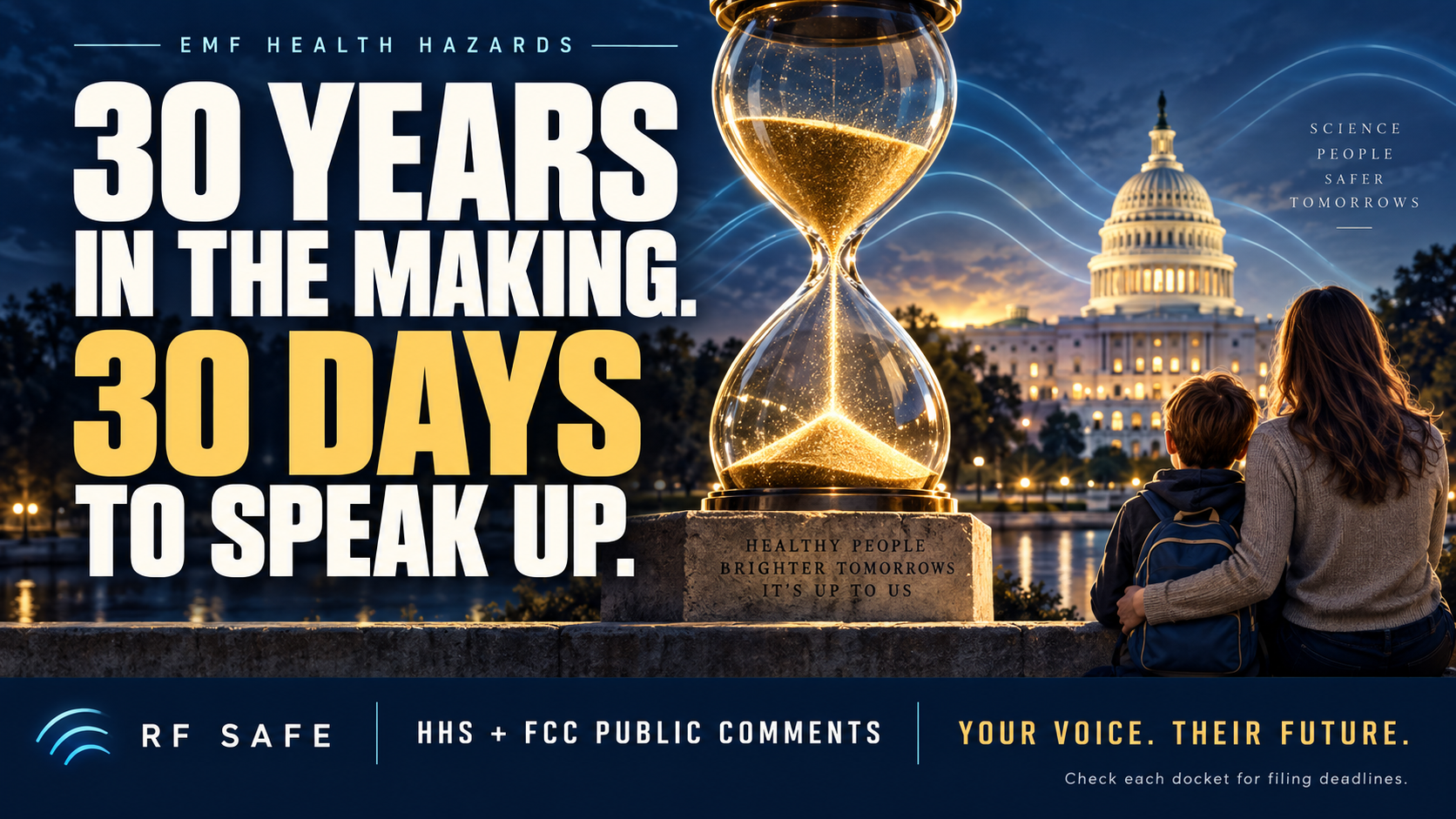
For years, families concerned about wireless radiation have faced a familiar answer: the device meets federal exposure limits.
That answer establishes regulatory compliance. The question families are asking is broader: how well do those limits protect a developing child, a pregnant worker, or a person living with repeated exposures over many years?
Now the Department of Health and Human Services is asking the public to help examine that question.
In his address, HHS Secretary Robert F. Kennedy Jr. connects wireless-radiation research to a larger commitment: investigate preventable contributors to chronic illness, examine the evidence independently, and act on what the science supports. The department’s official announcement invites input on health effects, exposure standards, research gaps, and practical ways to reduce unnecessary exposure.
For RF Safe, this is an opportunity to advance a position developed through decades of advocacy: the protection of children should drive communications policy, research priorities, and infrastructure design.
A public invitation becomes meaningful when people answer it. Researchers can identify overlooked experiments. Clinicians can describe patterns worth investigating. Engineers can explain exposure conditions and alternatives. Parents can explain the decisions they are being asked to make without adequate information.
Start with RF Safe’s public-comment action center. Read the evidence, prepare your own response, and submit it through the official government docket.
Deadline note: As of September 19, 2026, the HHS public-inspection notice is scheduled for Federal Register publication on September 21 and specifies a 30-day comment period. That would put the deadline on October 21 if publication proceeds as scheduled. Confirm the final deadline and availability of the Comment button in HHS docket HHS-OASH-2026-0397. The FCC has a separate proceeding and deadline; check both.
The commitment that deserves a public response
Kennedy states his responsibility plainly:
“My obligation is to demand evidence to fund the gold standard science and then to act where the evidence supports action.”
That commitment gives the public something concrete to ask for: funded research, transparent methods, independent scrutiny, and decisions that explain how the evidence was evaluated.
His remarks recognize parents and researchers who have spent decades raising questions outside government. Now, as HHS secretary, he describes an opportunity to bring federal resources to those questions. He also announces a review of the EMF regulatory landscape and a report planned for the fall.
The appropriate public response is to help define what a serious investigation must include—and to ask HHS to publish its methods, milestones, and findings.
An announcement alone does not measure a child’s exposure. A promise of research does not identify which experiments will be funded. A public comment can specify both the problem and the work needed to address it.
This is why participation matters beyond the number of submissions. A well-supported comment can place a neglected endpoint, a flawed assumption, or a feasible alternative directly before the agency.
Prevention means examining the environments children actually inhabit
Kennedy’s address ranges across food, physical activity, sleep, social connection, environmental exposures, research institutions, and medical oversight. The thread connecting these subjects is prevention: investigate the conditions shaping health before illness requires treatment.
Some of that prevention agenda has direct experimental support. In an NIH inpatient randomized trial, 20 adults ate roughly 500 more calories per day on an ultra-processed diet and gained weight, while losing weight during the unprocessed-diet period. The investigators controlled the offered diets in ways that helped isolate the effect of the dietary pattern. Hall and colleagues, 2019
That study illustrates the value of testing an environmental contribution rather than treating every health outcome as an individual failure. RF research needs comparably careful exposure characterization and experimental control.
Kennedy also addresses children’s screen use. Here, several exposures must be measured separately: content and social interaction, displacement of sleep or exercise, nighttime light, and RF emissions. Turning off a screen changes more than radiofrequency exposure. A study that distinguishes these factors can identify which intervention actually helps.
RF Safe’s broader position is that environmental contributors can interact. Nutrition, air pollution, sleep disruption, genetic susceptibility, existing illness, and physical exposures may affect overlapping physiological systems. The research question is how much a particular exposure contributes, under which conditions, and whether reducing it improves outcomes.
A preventable contributor does not have to explain every case of a disease to deserve attention.
That principle also sets a standard for interpretation: rising diagnoses or personal recollections do not identify a particular cause by themselves. They should lead to better exposure histories, age-specific analyses, and studies capable of separating competing explanations.
The lesson of lead is to measure what matters early
Kennedy invokes the history of lead research and Herbert Needleman’s work to explain why persistence in environmental health matters. One enduring lesson is that developmental effects can be consequential before they become an obvious episode of poisoning.
A pooled analysis of seven longitudinal cohorts found an association between childhood lead exposure and reduced intellectual performance, including among children with comparatively low measured blood-lead concentrations. Lanphear, Needleman, and colleagues, 2005
That history supports a methodological demand for RF research: select outcomes capable of detecting meaningful developmental changes, measure exposure carefully, and follow children over time. The evidence for lead establishes lead’s effects; RF requires its own evidence.
For public policy, the lesson is to fund the measurements early enough to inform prevention. A program limited to conspicuous injury will miss questions about subtle functional changes, susceptibility, and later consequences. Parents should not have to wait for a research system to develop those capabilities after an entire childhood has passed.
The evidence HHS needs to confront
RF Safe’s case begins with identifiable studies and measurable outcomes. The RF Safe research collection can help readers locate relevant papers; the original methods and findings should anchor a public comment.
The most useful submission explains what a study tested, what it found, and what action that finding warrants.
Animal cancer findings warrant an explicit risk assessment
The U.S. National Toxicology Program reported clear evidence of malignant heart schwannomas in male rats exposed to the tested cellphone RF signals, and some evidence of malignant brain gliomas. Those are the program’s formal evidence categories. The experiments involved prolonged whole-body exposures and therefore require careful translation to human exposure patterns. NTP’s findings and study explanation
The Ramazzini Institute’s lifetime rat experiment, using a different exposure arrangement intended to represent a GSM base-station emission, also reported an increase in heart schwannomas in males at its highest exposure level. The related tumor finding across different experimental designs is a reason to investigate the biological and dosimetric relationship closely. Falcioni and colleagues, 2018
A WHO-commissioned systematic review subsequently rated the evidence for increased gliomas and heart schwannomas in male rats as high certainty. Its 2026 correction retained those conclusions while correcting aspects of the underlying data and analysis. Mevissen and colleagues, original review; 2026 corrected publication
These findings justify a direct request: HHS should commission an independent assessment of what the animal evidence implies for human protection, identify the uncertainties explicitly, and fund the experiments needed to resolve them.
Fertility findings need their own assessment
The corrected WHO-commissioned male-fertility review reported high-certainty evidence of reduced pregnancy rates in mating experiments following exposure of male animals. This is a reproductive endpoint with practical biological significance. Its scope is male-animal exposure and subsequent reproductive success; it should be described that specifically. Cordelli and colleagues, review; correction
Public comments should ask HHS to evaluate fertility, prenatal development, and later reproductive function as distinct research questions. Exposure timing, temperature control, sex, life stage, and the outcome being measured all matter.
The Melnick–Moskowitz analysis challenges the basis of protection
In 2026, Ronald Melnick and Joel Moskowitz applied benchmark-dose modeling and conventional risk-assessment methods to animal cancer and reproductive data. They estimated cancer-risk-based exposure levels 15 to more than 900 times below the current public whole-body limit, depending on the dataset and assumed daily exposure duration. Their male-fertility calculations produced levels 8 to 24 times below that limit. Melnick and Moskowitz, 2026
The comparator was the 0.08 watts-per-kilogram whole-body limit, not the separate localized handset SAR limit. The cancer calculation used a target of one additional lifetime cancer per 100,000 exposed people. These are the authors’ model-based estimates using EPA-style methods, not a new EPA determination.
The policy question is substantial: What happens when RF exposure limits are evaluated using chronic cancer and reproductive endpoints rather than relying principally on thresholds for established acute effects?
HHS should reproduce the calculations, test their assumptions, compare alternative models, and publish the implications for standards. That is a concrete research and regulatory request readers can make.
Therapeutic RF makes biological specificity a practical research question
The FDA-authorized TheraBionic P1 delivers amplitude-modulated RF for certain adults with advanced liver cancer that has not responded to other treatments. It was approved through the Humanitarian Device Exemption pathway, which evaluates safety and probable benefit. FDA’s information also says the device should not be used by patients receiving calcium-channel blockers. FDA’s TheraBionic P1 overview
This is a concrete example of RF being used for a biological purpose under specific treatment conditions. Its therapeutic application supports investigation of frequency, modulation, cellular response, and exposure schedule. It does not establish that an unrelated wireless exposure produces the same response.
RF Safe’s phrase “If it can heal, it can harm” expresses a research principle: when an exposure can influence physiology, its benefits and hazards deserve investigation across the conditions in which people encounter it. The task is to map those conditions, including the boundary between a useful response, a reversible physiological change, and injury.
Human variability belongs in the study design
A 2025 randomized, sham-controlled study of 34 volunteers examined sleep EEG after 5G exposure and reported a genotype-dependent change in sleep-spindle frequency under its 3.6 GHz condition. The genetic grouping involved CACNA1C, a gene associated with an L-type calcium channel. The reported endpoint was a physiological change, not demonstrated disease. Sousouri and colleagues, 2025
The study provides a useful reason to fund replication that examines susceptibility rather than assuming everyone responds identically. Population averages can conceal differences among subgroups; small subgroup findings also need sufficiently large, preregistered confirmation.
For HHS, the practical request is straightforward: include genotype, developmental stage, health status, and recovery time in research where they are biologically relevant.
Why waveform and biological timing deserve attention
Living cells use electrical gradients and changing chemical signals to regulate their work. Calcium signals help coordinate secretion, metabolism, contraction, and gene expression. Their amplitude and duration can select different downstream responses, as established calcium-signaling experiments demonstrated decades ago. Dolmetsch and colleagues, 1997
This means an exposure investigation should examine more than whether a cell survives or whether its average temperature rises. It can also ask whether signaling remains appropriately timed and whether the cell returns to its baseline state after exposure ends.
A 2026 Cell study developed a gene switch responsive to a defined low-frequency laboratory field and identified CYB5B as an essential mediator. The investigators reported a role for rhythmic calcium dynamics in activating the engineered system. That supplies a specific experimental route for studying field-to-calcium-to-gene signaling. Kim and colleagues, 2026
RF Safe discusses the implications in “Cyb5b, Calcium Codes, and Low-Fidelity Biology.”
A carrier frequency and a signal’s timing pattern describe different features. A microwave carrier can be transmitted in bursts or have an amplitude envelope that changes much more slowly. Recording only the carrier frequency leaves out that temporal structure.
But a slowly varying RF envelope is not physically interchangeable with a standalone low-frequency magnetic field. Establishing a biological connection requires showing how the tissue detects or converts the modulated RF input. That missing experiment is a research priority.
HHS can ask researchers to compare well-characterized signals at matched absorbed power while changing modulation, pulse duration, repetition pattern, and recovery intervals. Temperature controls and sham exposures are essential to determining what actually drives a response.
The resulting evidence would address a question a simple average cannot answer: do exposures with similar energy deposition produce different biological outcomes because their timing differs?
Low-fidelity biology: a hypothesis HHS can put to a rigorous test
RF Safe’s Biological Receiver framework organizes the proposed research under S4–Mito–Spin:
- S4: voltage-sensing elements in ion channels, with studies asking whether particular external exposures alter channel behavior or calcium signaling.
- Mito: mitochondrial regulation of energy, calcium, and redox chemistry, with attention to recovery after a disturbance.
- Spin: magnetic-field-sensitive reactions in molecular systems that meet the requirements for spin-dependent chemistry.
These are candidate routes whose relevance must be established for the exposure being studied. The framework also asks whether an initial perturbation resolves or persists—a distinction central to determining its health significance.
Within this framework, bioelectrical dissonance describes a proposed disturbance of coordinated signaling. Low-fidelity biology describes the resulting loss of precision in processes such as timing, repair, and recovery. A meta-disease state is RF Safe’s term for a hypothesized upstream vulnerability that could increase the probability of several downstream disorders; it is not an established clinical diagnosis.
The value of this proposal depends on measurable predictions. Research could ask whether exposure changes calcium-oscillation regularity, mitochondrial membrane-potential recovery, metabolic coordination, or repair kinetics—and whether those changes precede and help explain an adverse outcome.
The public-health concern is about probability. An environmental contributor could make an uncommon outcome more frequent or bring an outcome forward in susceptible people without producing one distinctive disease in everyone exposed. That is the meaning of RF Safe’s formulation: the rare becomes less rare, and some failures may occur earlier.
For RF exposure, those population consequences remain predictions to test. Registry trends alone cannot establish the pathway. Strong studies need individual exposure estimates, appropriate comparison groups, competing risk factors, and follow-up long enough to examine the predicted sequence.
A useful federal program would also specify results that would count against the model. If its predicted signaling changes do not replicate under relevant exposures, the model must change. If they do replicate, the next task is to determine their persistence, health significance, and preventability.
This approach turns an explanatory framework into a research program with accountable milestones.
Harmful, beneficial, mixed, and null results all need careful interpretation
A literature containing different outcomes deserves investigation of why they differ. A therapeutic benefit can identify biological responsiveness. An adverse finding can identify a hazard. A null result can constrain the conditions under which a response occurs. A mixed study must be interpreted endpoint by endpoint.
These categories cannot simply be added together as votes for harm. Nor should a lack of effect under one experimental condition erase an adverse result obtained under another.
RF Safe’s strongest request is for research that makes studies comparable: published exposure specifications, blinded assessment, adequate statistical power, preregistered outcomes, accessible data, and independent replication.
The same accountability should apply to evidence reviews. HHS should disclose financial relationships, guideline-setting roles, review protocols, excluded studies, and the reasons for each certainty judgment. Technical criticism should address identifiable methodological choices. An affiliation alone cannot settle whether a result is correct.
Independence is a research-governance requirement. Transparency makes it possible to assess whether that requirement has been met.
The law already gives HHS a public-health responsibility
Public Law 90-602, the Radiation Control for Health and Safety Act of 1968, established a federal electronic-product radiation-control framework. Its current statutory provisions direct the HHS secretary to conduct a program involving research, standards, coordination, and work to minimize unnecessary radiation exposure. Current law: 21 U.S.C. § 360ii
Kennedy’s role therefore extends beyond inviting opinions. As secretary, he can direct attention, coordination, and resources within HHS’s lawful authority. Congress remains responsible for appropriations and any needed changes in statutory authority.
RF Safe’s call to reinvigorate Public Law 90-602 should be expressed through deliverables: a sustained research budget, an interagency plan, updated public guidance, modern exposure-assessment methods, and a public schedule for reviewing significant findings. RF Safe’s explanation of Public Law 90-602
The FCC proceeding addresses another part of the problem. Kennedy was among the attorneys listed on the petitioners’ briefs in the case decided in 2021. The D.C. Circuit found that the FCC had failed to give a reasoned explanation for its conclusion that its guidelines adequately protected against harmful effects unrelated to cancer. The court remanded the matter; it did not itself replace the exposure limits. Read the court’s decision
That history makes the administrative record important. Agencies need to address substantive evidence and explain their decisions. Readers can use RF Safe’s HHS–FCC action page to understand the two routes.
Kennedy also emphasizes that changes within government must survive procedural and legal scrutiny. Public participation helps supply the record for that work: sources, measurements, practical alternatives, and specific questions an agency can evaluate. Lasting reform needs both public insistence and a defensible evidentiary foundation.
Section 704 also deserves congressional scrutiny. The relevant provision restricts state and local regulation of the placement, construction, and modification of personal wireless facilities based on RF environmental effects when the facilities comply with FCC regulations. 47 U.S.C. § 332(c)(7)(B)(iv)
RF Safe’s policy argument is that the scientific adequacy of the federal limits becomes especially consequential when compliance constrains local decision-making. Congress should revisit that arrangement alongside any reassessment of health protection. Changing it requires legislative action; an HHS comment alone cannot repeal it.
Give agencies an alternative they can evaluate
Reducing unnecessary RF exposure should be an engineering objective alongside coverage, reliability, accessibility, and cost.
RF Safe advocates greater use of fiber, Ethernet, and optical wireless technologies, including Li-Fi compatibility. The practical proposal is to preserve connectivity while reducing reliance on RF for connections that can be served by other means.
A strong public request would ask for measured pilots in schools, childcare settings, healthcare facilities, and homes. Compare the actual RF emissions, service quality, energy use, installation costs, accessibility, and optical safety of different network designs. Evaluate the uplink and any wireless fallback as well as the advertised downlink.
That work can establish where a wired or optical option meaningfully reduces exposure while delivering the service people need. A compatibility requirement should be built around demonstrated performance, interoperability, and affordability.
RF Safe’s Clean Aether Act of 2026 model statute offers a proposal for organizing this policy discussion. It is a model for consideration, not an enacted law. The accompanying Non-Thermal EMF Mechanisms Science Supplement provides additional material readers can examine when developing their comments.
The public should be able to ask for both better evidence and better infrastructure.
What HHS is asking: 17 questions you can help answer
The HHS notice contains an instruction numbered 1 and 17 substantive questions numbered 2 through 18. You may answer the questions relevant to your knowledge. The prompts below summarize the topics; the suggested requests are RF Safe’s advocacy recommendations.
Question 2: Your perspective
Explain the experience you bring: parent, patient, worker, educator, clinician, researcher, engineer, or organization. Identify whether you are presenting personal observations, published research, technical measurements, or policy recommendations. A clear statement of perspective helps the agency interpret your contribution.
Question 3: Personal experiences
Describe observations accurately and without identifying private medical information. Distinguish measured exposure from an estimate and a symptom from a diagnosis. You can ask HHS to develop a standardized, privacy-protecting way to collect reports and identify patterns for follow-up.
Question 4: Professional observations
Clinicians and researchers can contribute information about assessment methods, recurring observations, and relevant exposure histories. Recommend standardized documentation and independent studies that can test the patterns you describe. Explain how alternative causes were evaluated where that information is available.
Question 5: Standards and regulatory improvements
Ask for a transparent comparison of existing standards with chronic-health risk-assessment methods. Recommend including waveform, exposure duration, simultaneous sources, body position, and life stage in research and reporting. Request evaluation of practical exposure-reduction techniques.
Question 6: Adequacy of current limits
Ask HHS to independently reproduce and assess the Melnick–Moskowitz calculations. Explain why cancer and reproductive endpoints warrant explicit consideration. Keep whole-body and localized limits distinct, and identify the exposure conditions associated with any study you cite.
Question 7: Available exposure-measurement methods
Engineers can describe personal dosimeters, calibrated field measurements, device operating logs, and computational dosimetry. Explain each method’s limitations, including whether it captures short bursts, multiple sources, or exposure close to the body.
Question 8: Better assessment of real-world exposure
Recommend measurements across a typical day, with sufficient time resolution to preserve relevant signal structure. Ask for validation against calibrated reference systems and for privacy safeguards when collecting device-use information.
Question 9: Disclosure
Request understandable information about operating modes, realistic exposure conditions, test configurations, and ways to reduce exposure. Schools and workplaces should have usable documentation of their network equipment and any independent measurements they commission.
Question 10: Surveillance
Propose prospective cohorts that combine exposure histories with health follow-up. Ask for age- and subtype-specific analyses where biologically relevant, while accounting for changes in diagnosis, screening, and registration. Surveillance should help generate and test hypotheses rather than assign causes from a trend alone.
Question 11: Potentially sensitive populations
Request research designed around development, pregnancy, aging, occupational exposure, implanted devices, and relevant medical conditions. Ask for sufficiently powered susceptibility analyses, including independent replication of genotype-related findings where warranted.
Question 12: Findings below federal limits
Provide original studies with enough dosimetric detail to establish the comparison. Identify the applicable limit, averaging interval, exposure location, and outcome. Request independent replication of credible adverse findings under matched conditions and appropriate thermal controls.
Question 13: Changing technology and cumulative exposure
Ask for research that captures the complete operating environment: phones, infrastructure, wearables, connected appliances, and other sources. Recommend measuring emissions under realistic workloads rather than assuming that a technology label defines exposure.
Question 14: Environmental effects
Request robust ecological studies with dosimetry, replication, blinded outcome assessment, and controls for temperature, light, moisture, and other environmental variables. Plant experiments can be useful when designed to distinguish an RF effect from differences in growing conditions.
Question 15: Infrastructure
Ask for transparent assessments around schools, childcare facilities, homes, healthcare settings, and workplaces. Recommend cumulative exposure measurements and comparisons with feasible alternative network designs. Distance alone should not substitute for a characterized exposure assessment.
Question 16: Research priorities
Call for independent long-term studies, developmental and reproductive research, replication of mechanistic findings, and experiments on timing and recovery. Ask HHS to publish priorities, budgets, protocols, milestones, and results—including findings that do not support the original hypothesis.
Question 17: Federal coordination
Recommend an accountable program linking FDA’s radiation-control responsibilities, NIH research, CDC surveillance expertise, and relevant EPA risk-assessment expertise, with a clear connection to FCC decisions. Ask the agencies to identify who owns each task and when the public will receive an answer.
Question 18: Additional recommendations
Present proposals for exposure-reducing infrastructure, Li-Fi compatibility studies, congressional review of Section 704, and sustained implementation of Public Law 90-602. Explain which agency or branch of government can carry out each request.
A strong comment connects evidence to a requested action
You do not need to reproduce an entire literature review. One clearly explained concern, a relevant source, and a specific request can be a useful contribution.
Use RF Safe’s evidence cards and comment worksheet to organize your response. The Safe Cellular Phones guide offers another route through the material.
The structure is simple:
- Explain why the issue matters to you and identify the questions you are answering.
- Present the evidence or observation you want considered.
- Explain what it supports and what the agency still needs to determine.
- Ask for a specific study, disclosure, policy evaluation, or other action.
- Include working source links and review the response in your own words.
Here is a starting point to adapt:
Response to HHS questions 5, 6, 11, 16, and 17
I ask HHS to commission an independent reassessment of wireless-radiation health protection, with priority given to children, reproductive health, and long-term exposure.
The National Toxicology Program’s animal findings, the WHO-commissioned animal-cancer review, and the Melnick–Moskowitz risk assessment warrant an explicit federal response. Please explain how these findings are incorporated into the evaluation of existing limits and identify the studies needed to improve estimates of human risk.
Research should characterize modulation, pulse timing, cumulative exposure, and recovery intervals alongside absorbed energy. Please fund independent studies that determine whether observed changes in calcium signaling, mitochondrial function, or sleep physiology persist, affect health, and vary across susceptible groups.
I also request measured comparisons of conventional wireless networks with fiber, Ethernet, and optical wireless alternatives in schools and other settings serving children. Evaluate Li-Fi compatibility as a practical exposure-reduction option, including interoperability, affordability, optical safety, and any RF uplink or fallback.
Please publish a coordinated research plan under the federal electronic-product radiation-control framework, with disclosed conflicts of interest, accessible methods and data, funding milestones, and a schedule for updating public guidance. The public needs to know who is responsible for answering these questions and when the answers will be available.
Add your own perspective and the issues you understand best. Genuine, well-supported submissions are more useful than duplicating a template without reading it.
How to put your voice into both federal records
For HHS: Open docket HHS-OASH-2026-0397 on Regulations.gov. Confirm the final notice and deadline, select the EMF request, and use its Comment button when available. Include the relevant question numbers. The notice calls for one response per person or organization and permits anonymous participation. Comments become public; follow its instructions to exclude private or sensitive information.
For the FCC: Use ECFS Express for proceeding 13-84, or ECFS Standard Filing when submitting attachments. Check the current FCC notice and its own filing deadline. Concentrate the response on the matters returned by the court, including the evidence relevant to non-cancer effects, children, long-term exposure, and environmental concerns.
An HHS submission does not automatically become an FCC filing. Keep a copy of each response and any confirmation the filing system provides. Use the action center’s filing guidance if you need help navigating the two processes.
Kennedy also mentions a separate vaccine-policy comment request during his address. Its near-term deadline is distinct from the EMF proceeding. Use the docket identifiers above and the official notices to keep the submissions on the right track.
Thirty years in the making. Make the comment window count.
The FCC’s exposure framework dates to 1996. Three decades later, connected devices occupy far more of daily life, and the research questions extend across development, reproduction, long-term exposure, biological timing, and environmental effects.
RF Safe’s position is that this record warrants sustained independent investigation and practical action to reduce unnecessary exposure. Families should have reliable information. Schools should have credible infrastructure choices. Researchers should have the resources to test difficult questions. Agencies should explain how the evidence informs protection.
Kennedy has made a public commitment to seek evidence, fund research, and act where warranted. The comment process is a way to place specific requests alongside that commitment.
Prepare your response. Submit it to the appropriate docket. Help someone else do the same.
Send this article to a parent, teacher, clinician, engineer, or researcher who can contribute something useful. Invite them to bring their own experience and expertise. The purpose is a public record rich enough to demand a serious answer.
Build your comment with RF Safe, follow the HHS docket, and make your FCC filing in proceeding 13-84.
Children cannot write the standards governing their exposure. The adults making those decisions can hear from us now.